Public Classes Brush Chipping Weed Abatement
Eucalyptus Risk Mitigation Program Print E-mail

Introduction

The Eucalyptus Risk Mitigation Program is an initiative funded by the Los Altos Hills County Fire District to try and responsibly reduce the risks that are posed by certain (not all) Eucalyptus trees in our district.

Voluntary - and not all Eucalyptus trees qualify

The program is entirely voluntary. Property owners can choose not to participate in this program, or they can opt to take advantage of it to reduce the risks associated with these trees. But by the same token, only certain Eucalyptus trees will be eligible under this program. Eligibility is determined on the basis of their Risk Score (this is explained further below) as determined by the Fire District's consulting arborist. So even though you may have Eucalyptus trees on your property, they may not score high enough to be eligible to be handled under this program.

What happens if I have trees that qualify?

If you are notified that your trees qualify and you are near the current top of the priority queue (based on your Risk Score), you will be contacted by the District's consulting arborist to arrange a meeting. At this meeting you can discuss the details of what measures are suggested for your property, and potentially have the plans refined to meet any constraints you might have. If you agree to what is proposed, you will be asked to sign an agreement permitting the work to be done. This work (which may involve anything from minor debris clean-up to trimming or even complete removal in certain cases) will then be performed at no cost to yourself.

How Does It Work?

The Los Altos Hills County Fire District sends out inquiry post-cards to homeowners within the district.

Based on response cards that are returned, residents who indicate an interest in the program are visited to permit an examination of the tree(s) in question and evaluation of the overall Risk Score for that property. This is derived from a number of separate factors which are combined via a formula to provide the overall score. Greatly simplified, these risk factors may be summarized as:

  • Grove Factor Applies to standing groves. A lone Eucalyptus in the middle of a field has a value of 1, a grove of three would have a value of 3, a grove of five would have a value of 5 etc. This factor may then be weighted further where the grove is surrounded by other combustible species.

  • Ground Debris Factor Applies to situations where there are broken branches, bark, or excessive dead vegetation debris on the ground under the trees (most commonly associated with Blue Gums). This factor may receive further weight along roadways, pathways, and near structures or other areas where intentional or unintentional ignition sources are more prevalent.

  • Shedding Bark Factor Applies to shedding bark and bark lodged in crotches (commonly associated with Blue Gums). Because of the volatile nature of the bark, this factor is given extra weight in areas where other ignition sources are present.

  • Low Branch Factor Applies to everything from 1" diameter waterspouts to the rare instances of 20"+ diameter low-growing limbs.

  • Endweight Factor Applies to certain high-risk Eucalyptus environments. These include trees with excessive end-weight over high-risk targets such as high-voltage lines, transformers, highly traveled roadways and occupied structures.

  • Deadwood Factor Applies to significant (2"diameter or greater) deadwood, primarily within the lower 40 feet of the tree, but it also applies to broken limbs hanging in the canopy. Because of the hazardous nature of these "widow makers" the factor is weighted to include removal of the limbs regardless of their height within the tree.

These risk factors are used to derive an overall Risk Score for a given property, and this then effectively ranks that property in a queue for consideration under this program. Properties with the highest risk will be tackled first to achieve the greatest risk mitigation (the goal of this program) and progressively to areas of lower risk.

Risk Scores - Some Examples

The Risk Score for a given property will be a number which can be anywhere from zero on up, but for purposes of illustration and discussion, a score will result in the property being categorized in one of the following levels:

  • Clean
  • Minimal
  • Minor
  • Moderate
  • Considerable
  • Extreme

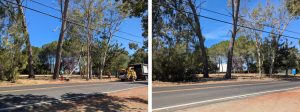
Some samples of actual situations within our district that reflect each of these categories are shown below:


Clean


Minimal


Minor


Moderate


Considerable


Extreme


Tree Removal in Public Right-of-Way

Under Town ordinances, homeowners are responsible for maintenance of landscape elements in the public right-of-way that abut their property. Where there are Eucalyptus trees in this public right-of-way that qualify for actual removal under this program, the Town of Los Altos Hills has agreed to waive any permit requirements that might be associated with such removal pursuant to the goals of the program.

Pruning and or removal of Eucalyptus trees in unincorporated areas of Santa Clara County may require a permit depending on tree size, parcel zoning, and tree location (road right-of-way).  The tree contractor will facilitate the permitting process by supplying all of the necessary paperwork and documentation for the permit.  This will be provided to the homeowner with the work authorization paperwork before any work is scheduled.”

 
SnowTech Media - Web Design San Francisco Bay Area