Los Altos Hills County Fire District

  • About
    • District Overview
    • Map of the District
    • District Services Guide
  • Programs
    • Home Ignition Zone (HIZ) Assessment and Rebate Program
    • Defensible Space Brush Chipping and Removal
    • Firewise USA®
    • Monthly Brush Drop Off Program
    • Community Emergency Response Team (CERT)
      • Join CERT
      • Already a CERT?
      • Teen CERT Program
      • CERT Calendar
    • Weed Abatement
    • Vegetation Management
  • Projects
    • Frequently Asked Questions (FAQs)
    • Current and Upcoming Projects
      • Arastradero Evacuation Route Project
      • Magdalena-Eastbrook Evacuation Route Project
      • I-280 Project
    • Projects Archive
  • Community Outreach
    • Preparing for Emergencies
      • Red Flag Warnings
      • Fire Extinguishers
      • LAH Resident “OK” Card
      • Youth Preparedness
    • Take A Class
      • 2026 Preparedness Calendar
      • 2025 Preparedness Guide
      • 2024 Preparedness Guide
    • Request a Presentation
  • Governance
    • Commission Overview
    • Meetings
    • Strategic Plan
    • Chart of Services
    • CWPP / Annex 4 / Addendum
    • Finances
    • Find Public Documents
  • Meetings
  • Contact Us
    • Contact Us
Home » Community Projects » Magdalena-Eastbrook Evacuation Route Project

Magdalena-Eastbrook Evacuation Route Project

Project Updates

Initial treatment was completed on November 8, 2024.

Maintenance treatment is scheduled for October 2026.

Project Description

The Magdalena-Eastbrook Evacuation Route Project in Los Altos Hills, California, provides an important route of egress route for a significant portion of the South-Eastern area of the Los Altos Hills Community in the event of a wildfire evacuation. To secure the integrity of this route, Los Altos Hills County Fire District and Santa Clara County FireSafe Council propose a roadside treatment of hazardous fuels.

You may read more about the project goals on the Santa Clara County FireSafe Council website.

Read the media release.


How to Participate in a Project Near You

  • Meet with a team member to discuss specific work on your property
  • Complete and return the Right of Entry (ROE) permit
  • Coordinate your work to remove hazardous vegetation on your parcel with the schedule of the evacuation route project in your area (sign up for our Defensible Space Brush Chipping and Removal Program)

Complete the Right of Entry (ROE) permit on the Santa Clara County FireSafe Council website

Before & After Photos

Mobile users: For the best experience, please rotate your phone to landscape mode.
mag-east-before-after-set-1
Low-growing tree branches and excess vegetation are cut away from the lower portion of the trees to create a separation between the tree canopy and ground fuels.

Low-growing tree branches and excess vegetation are cut away from the lower portion of the trees to create a separation between the tree canopy and ground fuels.

mag-east-maintenance-before-after-set-2
Hazardous vegetation, including brush, grasses, and tree limbs, is cleared to the fence line.

Hazardous vegetation, including brush, grasses, and tree limbs, is cleared to the fence line.

previous arrow
next arrow
 

Project Site

This project will treat seven (7) roads along the evacuation route. These include Magdalena Avenue, Camino Hermoso Drive, West Loyola Drive, Rolly Road, Kenbar Road, Sunhills Drive, and Eastbrook Avenue.

The northern end of the project is located at the intersection of Magdalena Avenue and Ravensbury Avenue (37.34964, -122.11142), and the southern end of the project is located at the intersection of Sunhills Drive and Mora Drive (37.33935, -122.10096).

This project will treat the following roads:

  • Magdalena Avenue from Ravensbury Avenue to Camino Hermoso Drive. Approximately 1.26 linear miles, 2.52 treated miles.
  • Camino Hermoso Drive from Magdalena Avenue to West Loyola Drive. Approximately 0.18 linear miles, 0.36 treated miles.
  • West Loyola Drive from Camino Hermoso Drive to Eastbrook Avenue. Approximately 0.91 linear miles, 1.8 treated miles.
  • Rolly Road from West Loyola Drive to Kenbar Road. Approximately 0.11 linear miles, 0.22 treated miles.
  • Kenbar Road from Rolly Road to Sunhills Drive. Approximately 0.09 linear miles, 0.18 treated miles.
  • Sunhills Drive from Mora Drive to W. Loyola Drive. Approximately 0.2 linear miles, 0.4 treated miles.
  • Eastbrook Avenue from Mora Drive to Magdalena Avenue. Approximately 1.01 linear miles, 2.02 treated miles.

Total treated area: approximately 3.76 linear miles, 7.52 treated miles.
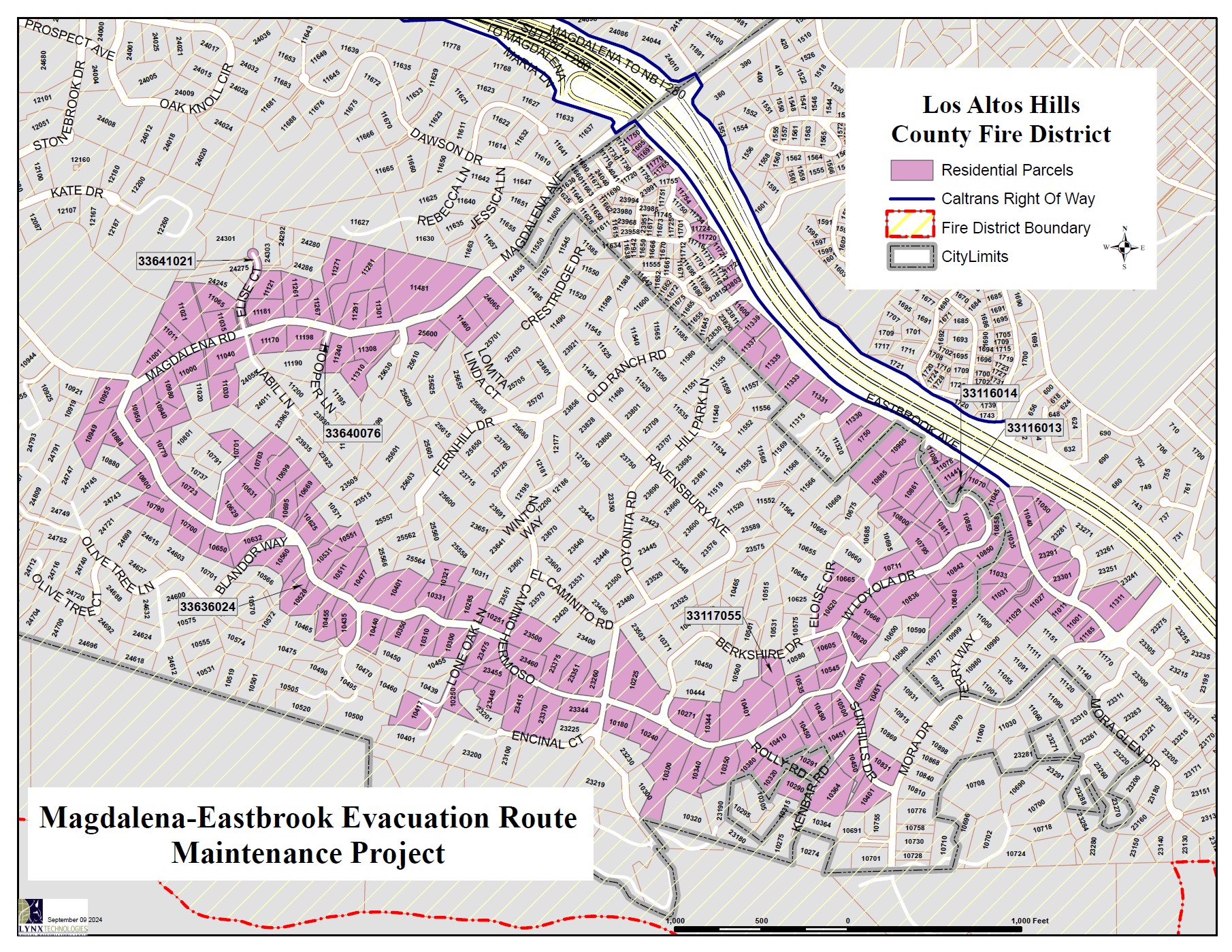
Magdalena-Eastbrook Parcel Map

Click to enlarge.


Treatment History

Magdalena-Sunhills Parcel Map

Click to enlarge.

2024 November Initial Treatment

The initial treatment of Magdalena – Eastbrook treated seven (7) roadways:

  • Magdalena Avenue from Ravensbury Avenue to Camino Hermoso Drive
  • Camino Hermoso Drive from Magdalena Avenue to West Loyola Drive
  • West Loyola Drive from Camino Hermoso Drive to Eastbrook Avenue
  • Rolly Road from West Loyola Drive to Kenbar Road
  • Kenbar Road from Rolly Road to Sunhills Drive
  • Sunhills Drive from Mora Drive to W. Loyola Drive
  • Eastbrook Avenue from Mora Drive to Magdalena Avenue
  • Project length: approximately 7.5 treated miles
  • View Final Report
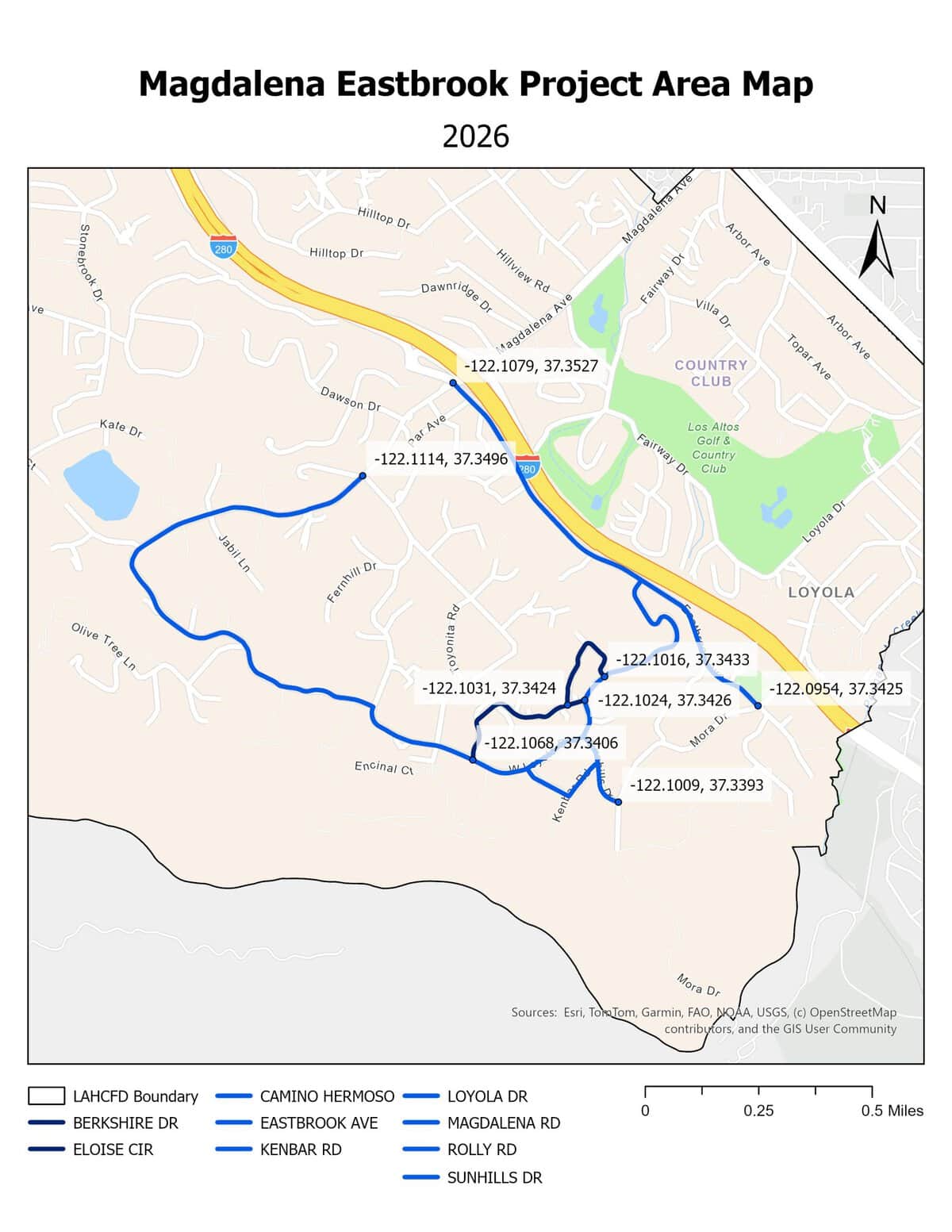
Magdalena Eastbrook 2026 Project Area Map

Click to enlarge.

2026 October Maintenance Treatment

The maintenance treatment of Magdalena – Eastbrook will add two (2) tributary roads to the project scope and treat a total of nine (9) roadways:

  • Magdalena Avenue from Ravensbury Avenue to Camino Hermoso Drive
  • Camino Hermoso Drive from Magdalena Avenue to West Loyola Drive
  • West Loyola Drive from Camino Hermoso Drive to Eastbrook Avenue
  • Rolly Road from West Loyola Drive to Kenbar Road
  • Kenbar Road from Rolly Road to Sunhills Drive
  • Sunhills Drive from Mora Drive to W. Loyola Drive
  • Eastbrook Avenue from Mora Drive to Magdalena Avenue
  • Berkshire Drive from W. Loyola Drive to W. Loyola Drive
  • Eloise Circle from Berkshire Drive to W. Loyola Drive
  • Project length: approximately 8.8 treated miles
  • View Final Report


Frequently Asked Questions (FAQs)

What happens to the vegetation that Los Altos Hills County Fire District cuts down?
How will it look when the project is finished?
How does vegetation management help roadway visibility?
What is the Right of Entry (ROE)?
What is a Riparian area or zone?
What kind of preparation is done for vegetation management?
Do eucalyptus trees specifically contribute to wildfire risks?
How can we maintain eucalyptus trees to prevent wildfire?
How is traffic controlled at the project sites?
How are these projects scheduled for traffic control?
Roadside maintenance projects: how important are they?
What is the importance of an evacuation route during a wildfire?
Why is it important to focus on intersections?
How far should the vegetation be trimmed or cut?

  • Accessibility Statement
  • General & Social Media Disclaimers
  • Privacy Policy

© 2026 Los Altos Hills County Fire District · All Rights Reserved
Web Services by Watchdog Studio

X YouTube Instagram Alert SCC Nixle Fire Safe Nextdoor Watch Duty Facebook LinkedIn